Food Photography for Restaurants and Cafés: From Plate to Delivery App
How to photograph your restaurant's dishes with window light, deliberate angles and honest styling that shows the food as it arrives, plus how to keep a whole menu consistent.
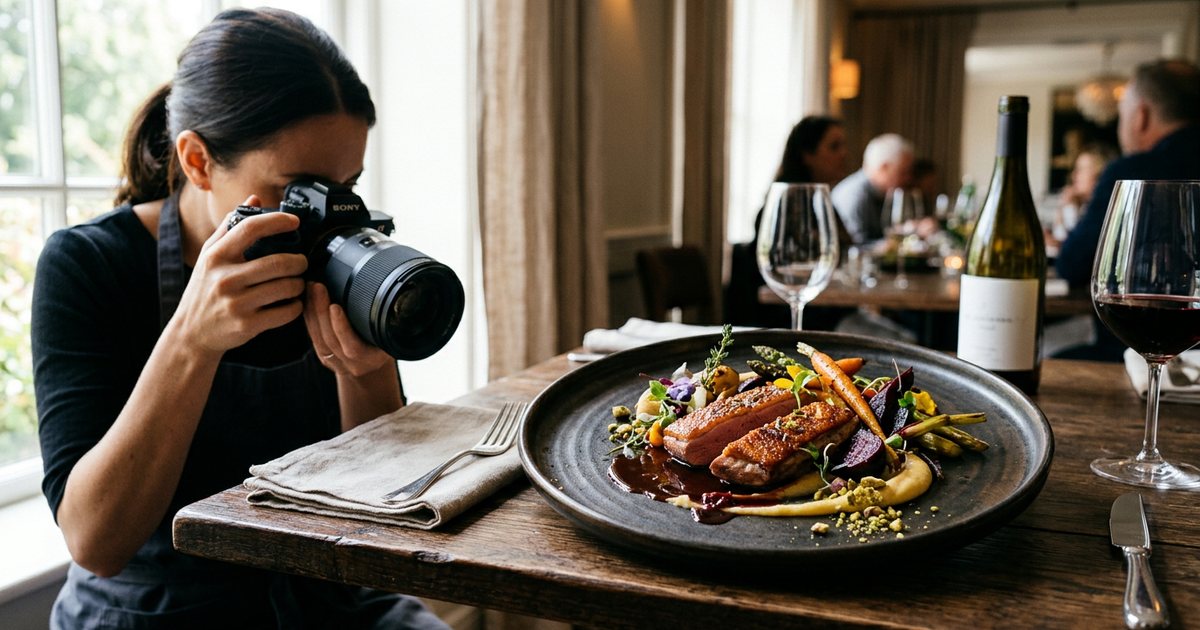
Food photography for restaurants and cafés has one job: show customers the dish as it will actually arrive, and make them want to order it. That rests on four things: careful styling, an angle that suits the dish's shape, soft side light that reveals texture, and consistency so the whole menu looks like one body of work. This guide walks through each step in a way you can apply with a professional camera or a good phone, with a focus on menus and delivery apps.
Honesty first: the photo is a promise
A dish photo on a menu or delivery app is a promise. If the order arrives looking different, you get bad reviews and refund requests, and you may attract attention under consumer-protection rules, which in many countries prohibit misleading advertising. Check the rules that apply with the competent authority where you operate. These rules mark the line:
- Photograph the real dish, with its real recipe, ingredients and serving size.
- Use the restaurant's own plates so customers read the portion size correctly.
- No inedible substitutes, such as glue for milk or mashed potato for ice cream. Those old advertising tricks have no place in menu photography.
- In editing, correct color and exposure and clean up crumbs, but never add an ingredient that is not there or enlarge the portion.
Styling basics any kitchen can manage
Food styling is a profession in its own right, but the basics are within reach of any organized kitchen:
- Work with the chef. Plate with more care than at the dinner rush, but with the same components.
- Show the hero ingredient: cut a sandwich to reveal the filling, expose the layers of a kunafa, put the best pieces of meat at the front.
- Build height in salads and rice dishes instead of spreading them flat. Height gives the picture depth.
- Wipe plate rims with a paper towel or cotton bud before every shot.
- Garnish only with herbs and spices that are really in the dish, such as parsley in tabbouleh or sumac on fattoush.
- Leave empty space in the frame if the image will carry text in an ad.
One of the most useful habits is the stand-in plate. Use a first plate to set the light and composition, and when everything is ready the kitchen sends out the fresh hero plate, which you shoot within minutes.
The right angle for each dish
No single angle suits every food. Choose the angle based on where the dish's appeal lies: on its surface, in its height, or in its overall look.
| Angle | Suits | Why |
|---|---|---|
| Overhead (90°) | Pizza, flat plates, bowls such as hummus and salads, shared spreads | Shows arrangement and variety; no depth is lost |
| About 45° | Most mains, such as mandi, kabsa and grills | Matches the view of someone seated at the table |
| Plate level (0 to 15°) | Burgers, sandwiches, layer cakes, drinks in tall glasses | Shows height and layers |
Try two angles for each new dish, then commit to one. For arranging elements within the frame, see Composition Rules in Photography. At 45° and plate level, focus on the front third of the hero item and use f/2.8 to f/5.6 to soften the background. Overhead, stop down to around f/8 so everything is sharp. A tripod locks the framing and lets you keep ISO low however long the exposure gets.
Window light: the best free light for food
Side light from a window is the workhorse of food photography because it is soft and reveals texture. To get the most from it:
- Position the dish so light comes from the side or from behind at an angle, roughly ten or two o'clock relative to the camera. Backlight makes sauces glisten, shows steam and makes drinks glow.
- Avoid flat front light and direct on-camera flash.
- If direct sun comes in, hang a thin white curtain or diffusion fabric over the window.
- Use a white card opposite the window to lift shadows, or a black card to deepen them for a moodier look.
- Switch off the restaurant's interior lights. Mixing daylight with warm bulbs gives food unnatural color casts.
In the Gulf and Egypt, where the sun is strong most of the year, north-facing windows usually give steadier indirect light through the day. For a deeper look at the direction and quality of light, read Lighting in Photography. If you shoot on a phone, the same rules apply, with extra tips in Professional Smartphone Photography.
Honest freshness tricks
Food loses its shine and life within minutes of plating. These tricks restore its natural look without deceiving anyone, because they do not change what the customer will eat:
- Coordinate with the kitchen so each dish is plated the moment you are ready, not before.
- Brush grilled meat and vegetables with a thin coat of the same cooking oil to bring back the shine they lose as they cool.
- Mist salads and fruit lightly with water, and chill glasses in advance so condensation forms naturally.
- Add sauce at the last moment so it does not soak in.
- Keep herbs in cold water until you need them.
- Shoot real ice cream fast: set everything up on a stand-in first and use plates chilled in the freezer.
- To capture real steam, use a dark background and backlight. Do not paint in fake steam during editing.
Props and color
Props create context, but they must never steal attention from the food:
- Matte plates in neutral colors such as white, gray and earth tones cut reflections. Ideally, use the restaurant's own tableware.
- Textured surfaces such as wood, marble and linen add warmth. Settle on one or two surfaces for the entire menu.
- A hand tearing bread or pouring tea adds life and movement.
- Local context, such as a dallah and finjan with Arabic coffee, glass tea cups in an Egyptian café, or lanterns for Ramadan content, brings the image closer to its audience, as long as the frame stays uncluttered.
For color, use contrast between complementary colors, such as green herbs on a red sauce. Color Theory and Color Psychology in Design explains these relationships. Brown dishes such as ful, koshari and stews need a touch of color from ingredients genuinely in them, like parsley, lemon or onion, and raking side light to bring out texture.
Menus and delivery-app images
Each delivery app has its own requirements for aspect ratio, minimum resolution, whether text, logos or borders are allowed, and background color. The same image is often cropped two ways: once in the restaurant listing and again on the dish page. So:
- Keep the dish centered with a generous margin on every side so it survives any crop.
- Do not put text or prices on the image unless the platform allows it.
- Read the platform's current guidelines before the shoot, whether it is Talabat, Deliveroo, Jahez, HungerStation, Elmenus or another app, because these requirements change.
- For a printed menu, prepare images at 300 PPI at final size and let the designer handle color conversion, as covered in Preparing Print Files.
- For social media, a 1080 × 1350 px portrait suits feed posts and 1080 × 1920 px suits stories; see Designing Social Media Posts.
Name files with the menu item code, for example MAIN-012_machboos_1x1.jpg, so the marketing team can upload them without mistakes.
Consistency across the whole menu
A menu whose photos vary in background and light looks amateur even when each photo is good on its own. To get consistency:
- Build a shot list of every item, grouped by category, with the angle and aspect ratio for each category.
- Lock the background, plate family, light direction, focal length and camera height, and mark the plate position on the surface.
- Shoot a full category in one session, with a kitchen schedule for sending dishes out one after another.
- Apply one edit preset to the whole category, as described in Photo Editing: A Professional Workflow.
- Document the setup with a photo and a simple sketch so new items can be shot the same way later.
Illustrative example: a café in Kuwait has 40 items. Drinks could be shot at glass level on a dark background, desserts at 45°, and breakfast overhead on a single wooden surface. Customers then see three clear, consistent styles instead of 40 unrelated photos. Plan seasonal shoots, such as a Ramadan iftar menu, weeks ahead, as covered in Planning Seasonal Campaigns. On a tight budget, Product Photography for Online Stores on a Budget has useful low-cost ideas, and Photography Fundamentals: The Complete Guide covers the underlying basics.
Practical checklist
- Honesty: real dish, real serving size, the restaurant's own plates.
- Preparation: shot list, chosen background and surface, a stand-in plate for setup.
- Light: side or back window light, a diffusion curtain, a white card, interior lights off.
- Angle: chosen by the dish's shape and fixed for each category.
- Freshness: plate on demand, a light brush of oil, a water mist, sauce at the last moment.
- Delivery: versions sized for delivery apps, social and print, files named by item code, and each platform's guidelines checked.